
Systems Theory of Management & Organizations
Systems Theory of Management & Organizations: A Holistic View of Business Entities
The Systems Theory of Management (also known as Systems Theory in Organizations) is a foundational concept that views companies and organizations as complex systems. These systems are comprised of interconnected and interdependent parts that operate within, and are significantly influenced by, an external environment. This theoretical framework provides a systematic way to explain organizational dynamics, emphasizing the intricate relationships between internal components and the crucial impact of external factors. It operates on the core principle that organizations are inherently open systems, constantly interacting with their surroundings, exchanging resources, information, and energy, and adapting to changes within their operational context.
This comprehensive approach understands that organizations are built from various interdependent subsystems, such as human resources, finance, production, and marketing departments. These subsystems collaborate internally and engage with external entities, forming a dynamic network of interactions and flows. Systems theory offers a holistic and multidimensional perspective, highlighting how changes in one subsystem can ripple through others, and how external forces—like market trends, technological advancements, or regulatory shifts—profoundly affect an organization’s functioning and performance.
Contents
The Organization as a System
The systems approach conceives of an organization as a set of interrelated parts, or subsystems, where each fulfills specific functions to achieve a common overarching objective. Organizational experts apply this approach to gain a broader perspective and a deeper understanding of an organization’s intricate functioning.
Today, numerous disciplines contribute to the study and resolution of organizational problems. Beyond psychologists, sociologists, and anthropologists—who were central to the Human Behavior School of Management—contemporary approaches also involve industrial engineers, administrators, statisticians, and economists, among others. All these management schools of thought now converge, with their individual contributions enriching modern management theory, though some are applied more prominently than others.
Systems theory distinguishes itself from other schools, such as the human behavior school, by studying the different elements of the system, their interrelations, processes, and objectives. While the human behavior school focuses on the individual as the most important element whose behavior influences others and underpins organizational success, systems theory emphasizes how all these diverse elements interrelate to achieve collective goals.
Related: Human Behavior School of Management
Types of Systems
In systems theory, two primary types of systems are identified:
- Closed Systems: These do not interact with their environment.
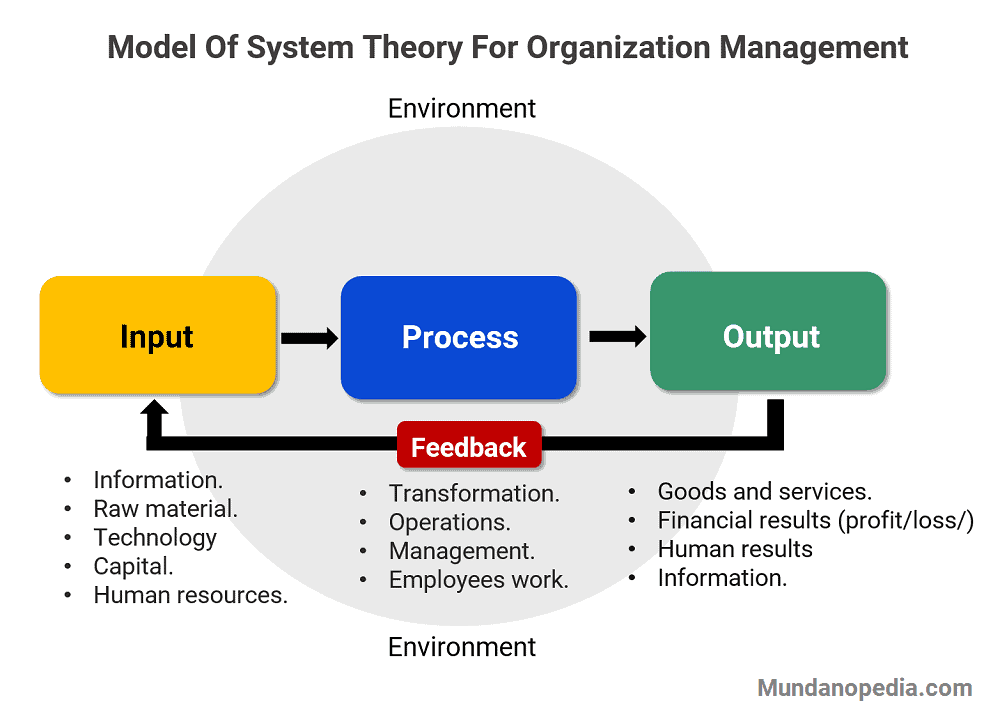
- Open Systems: These actively receive inputs (such as raw materials, information, or energy) from the environment, process them internally, and then return them to the outside as finished products or services.
The Organization as a Closed System
Historically, during the initial studies of organizations, they were predominantly viewed as closed systems. The focus was primarily on achieving greater internal efficiency at a technical-operative level, largely ignoring external influences from the environment. This perspective was common in early management theories that emphasized internal control and predictability.
The Organization as an Open System
Currently, modern organizational theory conceptualizes the organization as an open system. This perspective acknowledges its profound and intimate relationship with the environment (society at large). From this environment, the organization continuously receives energy, information, and materials. It then processes these inputs and returns them to the outside as valuable products or services that satisfy needs, creating a continuous and repetitive cycle of exchange and adaptation.
Characteristics of Open Systems
Open systems possess specific characteristics that enable their survival and dynamic interaction with their surroundings:
- Combat Entropy: They have the capacity to maintain and increase their level of organization and complexity, counteracting the natural tendency towards disorder.
- Maintain Stability (Homeostasis): Despite external fluctuations, open systems strive to maintain a dynamic equilibrium.
- Receive Feedback: They utilize information about their output and environmental responses to identify deviations, correct errors, and continuously improve performance.
Applications of the Open Systems Approach
This approach has provided invaluable insights, shaping various points of view in organizational studies:
- The organization as a subsystem within society: Recognizing its embeddedness and reliance on a larger societal context.
- As a set of functional subsystems: Viewing departments (e.g., finance, marketing, operations) as interconnected parts working towards common goals.
- Enables visualization with fundamental elements: Facilitating the understanding of the organization through its core components: environment, objectives, structures, and processes.
Importance of the Systems Theory of Management
The environment is an essential component of organizations because it directly and indirectly influences what happens internally, acting as a crucial determining factor.
Organizations interact with an immediate environment (also known as the microenvironment), which includes direct stakeholders such as customers, suppliers, advisors, regulatory entities, competitors, and public opinion. They also operate within a general environment (or macroenvironment), which encompasses broader societal factors including social, cultural, economic, and political realities. Management must thoroughly understand this multifaceted environment to ensure the organization’s adaptation and long-term viability. This understanding also equips leaders to navigate varying levels of complexity and uncertainty, whether the environment is predictable, disturbed, or turbulent.
The Systems Theory School (Administrative Thinking)
The Systems Theory School represents a distinct school of thought in administrative thinking. It emerged during a period of significant technological advancements and accumulated knowledge from the experiences of previous schools. This school addresses certain omissions made by the classical and behavioral management theories, differentiating itself through its distinct values, level of analysis, and methodology.
Systems theory extends beyond the study of individuals and their behavior, as its primary level of analysis is based on the concept of systems: a comprehensive set of interrelated elements working towards a shared objective. While the individual is indeed an important element within the system, the core focus of this school is on how all these diverse elements interrelate and interact.
Furthermore, this theory acknowledges that no single correct way exists to manage and organize a business, as the optimal approach is highly dependent on the specific environment in which the organization operates. This adaptive perspective is a hallmark of modern organizational thought.
Features of Systems Theory
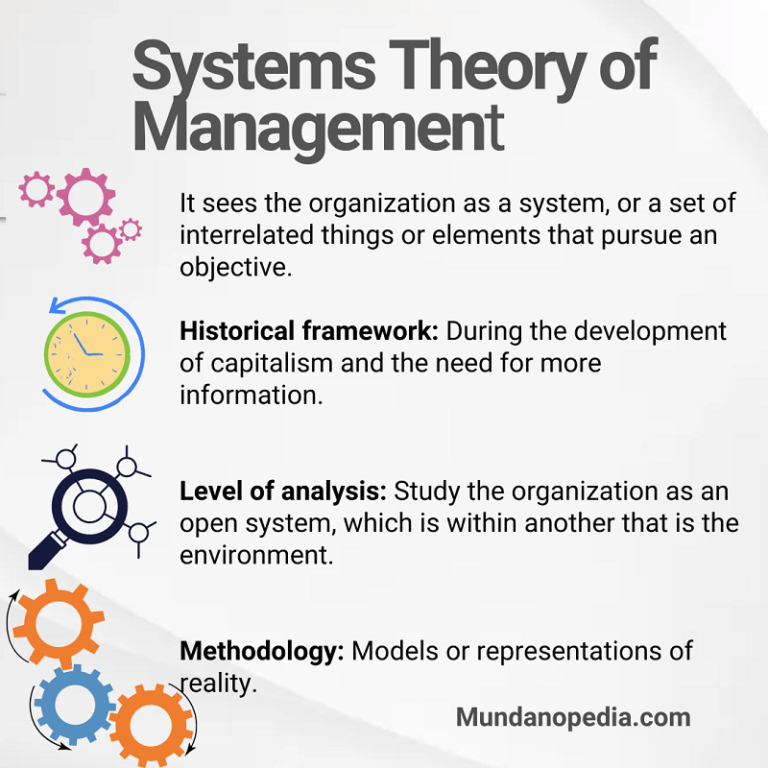
- Historical Framework: It developed concurrently with the growth of capitalism, the rise of large corporations, and the increasing demand for comprehensive information management.
- Level of Analysis: It examines the organization as an open system, which exists within and interacts with its broader external environment, exchanging vital resources and information.
- Methodology: Its methodology relies on the use of models or simplified representations of reality. This allows for the use of relevant variables to describe, explain, and forecast the behavior of systems under various conditions.
- Value System: It is underpinned by two fundamental concepts:
- All organizations, regardless of their specific sector or industry, share common structural features.
- Organizational activities are often regular and repetitive, making their behavior, to a certain extent, predictable.
Criticism and Limitations of Systems Theory
Despite its significant contributions, Systems Theory has faced several criticisms and recognized limitations:
- Limited consideration of the “human factor”: Critics argue it sometimes overlooks the spontaneity, unpredictability, and complex motivations of individual behavior within organizations.
- Ignores organizational differences and dynamism: There’s a tendency to generalize, potentially understating the unique characteristics and dynamic changes within different types of organizations.
- Difficulty in empirical verification: Some systemic concepts can be abstract, making their empirical verification challenging.
- Complex non-quantifiable extra-organizational factors: The existence of intricate external factors that are difficult to measure or quantify can complicate systemic analysis.
Contributions of Systems Theory
The contributions of the Systems Theory School to management thought are substantial:
- Identification and characteristics of organizational components: It provides a clear framework for breaking down and understanding the various parts of an organization.
- Currently valid theory: It remains a highly relevant and fundamental theory for studying and comprehending contemporary organizational phenomena.
- Greater organizational understanding: This holistic approach significantly facilitates effective planning, organization, direction, and control within management.
See also